Why Roman Concrete Still Exists While Modern Concrete Cracks
Modern concrete often begins failing within decades. Roman concrete is still standing after 2,000 years. Which raises a slightly uncomfortable question:
Why were people carrying swords and wearing sandals, apparently better at making concrete than we are?
That question has fascinated engineers, chemists, archaeologists, and historians for decades. And the answer turns out to be one of the most interesting engineering stories in civilisation.
Because Roman concrete was not just “good for its time.”
In some situations, it may actually outperform modern concrete.
And the reason why tells us something bigger about technology, materials, industry, and the strange habit humans have of occasionally forgetting useful things.
Concrete Is The Most Important Material You Never Think About
Concrete is everywhere.
Modern civilisation quietly depends on it.
- Roads
- Dams
- Bridges
- Apartment towers
- Airports
- Tunnels
- Ports
- Sewage systems
- Wind farms
- Data centres
After water, concrete is probably the most heavily used substance on Earth. Humanity produces billions of tonnes of it every year. And yet most people rarely think about how astonishing that really is.
Concrete is essentially artificial stone. We take loose material, mix it together, pour it into shape, and it hardens into something capable of holding up skyscrapers.
The problem is longevity.
Modern reinforced concrete often begins deteriorating surprisingly quickly. Sometimes within decades. Steel reinforcement corrodes. Water enters microscopic cracks. Freeze-thaw cycles expand damage. Salt accelerates decay. Maintenance becomes endless and expensive.
Entire industries now exist largely because modern concrete constantly needs repair.
The Romans, meanwhile, built structures that have survived two millennia. The Romans built things expecting civilisation to continue.
Modern infrastructure is often built expecting quarterly reports to determine whether a footpath, road, or motorway has the required usage to justify its continued existence.
Not all Roman buildings survived, of course. But the durability gap is still extraordinary. Especially in marine environments.
Modern seawater is brutal on concrete. Roman seawater structures often became stronger over time.
That last sentence sounds almost fictional. But it is true.
The Secret Ingredient Was Volcanic Ash
Roman concrete was called opus caementicium.
Its basic ingredients were fairly simple:
- lime
- volcanic ash
- water
- rock fragments
The critical ingredient was volcanic ash known as pozzolana, named after Pozzuoli near Naples. This ash changed everything. When mixed with lime and seawater, it triggered chemical reactions that modern scientists still study with admiration.
Instead of weakening over time, the material continued forming interlocking mineral structures. Tiny crystals grew within the concrete. Those crystals helped resist cracking.
In some marine structures, seawater actively contributed to strengthening the material over centuries. That is the part modern engineers find almost offensive.
Seawater normally destroys concrete. Roman concrete used it almost like a training partner.
The Pantheon Should Not Still Exist
If you want to appreciate Roman engineering properly, look at the Pantheon in Rome.
Built nearly 2,000 years ago, it still possesses the world’s largest unreinforced concrete dome. No steel skeleton. No hidden modern frame.
Just Roman engineering.
The dome weighs thousands of tonnes. And yet it still stands.
Modern engineers studying the structure discovered something clever: the Romans varied the concrete mixture throughout the building.
- Heavier volcanic rock lower down
- Lighter volcanic material higher up
The structure becomes less dense as it rises.
In other words, they were optimising load distribution centuries before modern structural engineering formally existed. Not through computer simulations. Through observation, experimentation, and accumulated craft knowledge.
Roman Harbours Are Even More Impressive
Buildings are one thing. Marine structures are another. Saltwater destroys almost everything eventually.
Modern ports require constant maintenance. Corrosion never sleeps.
Yet Roman harbour structures in places like Caesarea and Pozzuoli survived repeated wave attacks for centuries.
Scientists studying samples discovered rare minerals forming inside the concrete through interaction with seawater.
One mineral in particular — aluminous tobermorite — appears to strengthen the structure over time.
This is where the story becomes genuinely fascinating.
Modern concrete is largely designed around speed and cost. Roman concrete was designed around endurance. The Romans were not trying to finish a commercial development before quarterly earnings reports arrived. They were building infrastructure for an empire they expected to outlive them.
That mindset changes engineering decisions.
Modern Concrete Was Optimised For Something Else
At this point, people often assume modern engineers are simply worse.
They are not.
Modern concrete has different priorities.
It is designed for:
- speed
- mass production
- predictable curing
- standardisation
- compatibility with steel reinforcement
- rapid construction schedules
- economic scalability
Roman concrete cured slowly. Very slowly.
Modern economies hate slow processes.
Today, a delayed construction project can cost millions.
So modern cement — particularly Portland cement — became dominant because it sets quickly and works efficiently in industrial systems.
The trade-off is durability. Especially when exposed to harsh environments.
In other words:
modern concrete was optimised for economic speed, not eternal survival.
That is not stupidity. It is economics.
There Is Also A Lesson About Lost Knowledge
People like to imagine technological progress as a straight upward line.
It is not.
Human history is full of forgotten techniques.
- The Romans lost advanced glass formulas
- The Greeks lost certain fire technologies
- Ancient builders understood passive cooling systems modern cities are rediscovering
- Traditional shipbuilders possessed astonishing navigation knowledge before electronics existed
Civilisation forgets things surprisingly often. Sometimes because empires collapse. Sometimes because industrial systems replace craft traditions. Sometimes because a cheaper method becomes “good enough.”
Roman concrete partly disappeared because the entire Western Roman system collapsed. Trade networks failed. Skilled labour dispersed. Knowledge transmission weakened.
And once a technique vanishes across generations, rediscovering it can take centuries.
That should make us slightly humbler about our own civilisation. We assume the future automatically preserves useful knowledge. History suggests otherwise.
Scientists Are Trying To Bring Roman Techniques Back
Researchers are now actively studying Roman concrete to improve modern sustainability and durability.
Why this matters is simple and yet profound: because cement production is environmentally expensive. Modern cement manufacturing produces massive carbon emissions globally. If longer-lasting materials reduce rebuilding cycles, the environmental benefits could be significant.
Scientists have also discovered evidence that Roman concrete may have possessed a kind of self-healing capability. Tiny cracks allowed water infiltration, which triggered mineral growth that partially resealed fractures.
Again, this sounds futuristic. In reality, it is ancient.
Several modern experimental materials are now attempting to replicate similar behaviour. The strange irony is that some future construction technologies may end up looking partially Roman.
Why This Story Fascinates People
The Roman concrete story scratches several very human psychological itches simultaneously.
It combines:
- mystery
- lost knowledge
- engineering brilliance
- empire
- practical science
- historical continuity
- hidden complexity
It also quietly challenges modern assumptions…
We tend to believe newer automatically means better. But history is messier than that.
The Romans lacked electricity, antibiotics, satellites, and internal combustion engines. But in one highly specific field — ultra-long-term marine concrete durability — they may genuinely have solved problems we still struggle with.
That is both impressive and oddly comforting.
Human intelligence did not suddenly appear in Silicon Valley. People have always been clever. Ask your grandfather (and listen to what he says in response!)
The Bigger Lesson Hidden Inside A Pile Of Concrete
Roman concrete also reveals something important about civilisation itself.
Great societies do not only build for immediate convenience. They build for continuity.
Aqueducts. Roads. Ports. Libraries. Harbours. Drainage systems.
The Romans understood infrastructure as legacy. Modern societies often think in much shorter cycles:
- election cycles
- quarterly reports
- development returns
- rapid expansion
- short-term efficiency
Sometimes that works brilliantly. Sometimes it produces buildings requiring major repairs within 40 years.
The Romans were imperfect in countless ways. Brutal in many. Romanticising empires is dangerous and often flawed by small gaps in our knowledge. But The Romans took public infrastructure seriously (- we can see that even today, without having to read about it).
Very seriously.
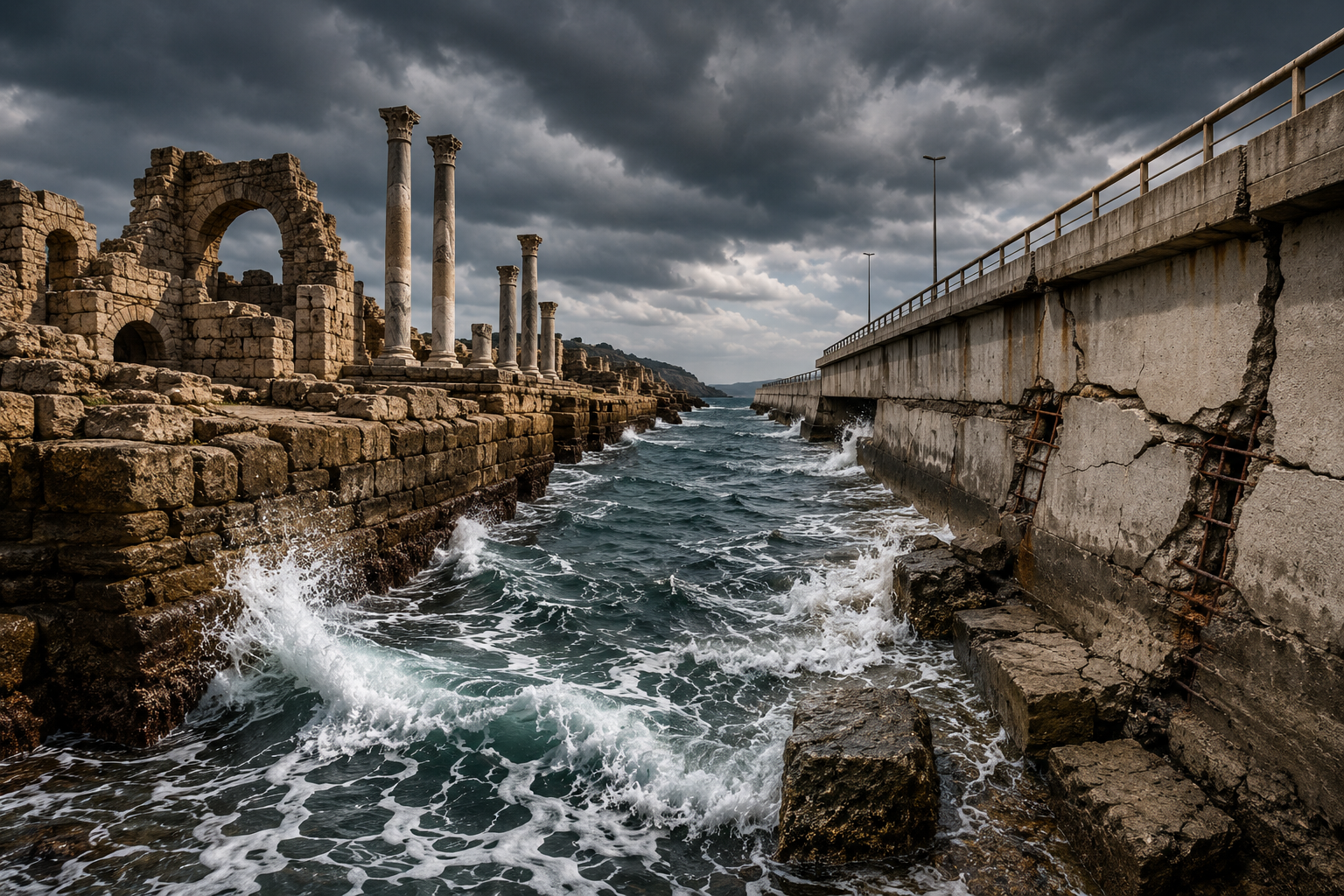
And two thousand years later, parts of that infrastructure are still quietly standing in sea spray while modern concrete nearby slowly cracks apart. That tends to get people’s attention.
And Now You Know
Roman concrete survives because the Romans discovered a volcanic ash mixture that interacted with water in unusually durable ways.
Modern concrete was optimised for speed, scale, and industrial economics instead. Which means one of the world’s most advanced civilisations may still have something useful to teach ours:
sometimes building slower builds longer.
And somewhere along the Italian coast, waves are still crashing against Roman harbour walls that were already ancient before the first Viking ship ever left Scandinavia.
That is difficult not to admire.
Join EVERY MAN AND HIS DOG
Strange curiosities. Forgotten wisdom. Fascinating facts. Delivered daily.
Join the newsletter for remarkable stories, useful knowledge, fascinating history, and the kind of facts worth passing on.
One response
Hi, this is a comment.
To get started with moderating, editing, and deleting comments, please visit the Comments screen in the dashboard.
Commenter avatars come from Gravatar.